
The conflict between the United States and Iran is one of the most important geopolitical issues of the modern world. For decades, tensions between the two countries have affected the Middle East, global oil prices, international trade, and world politics.
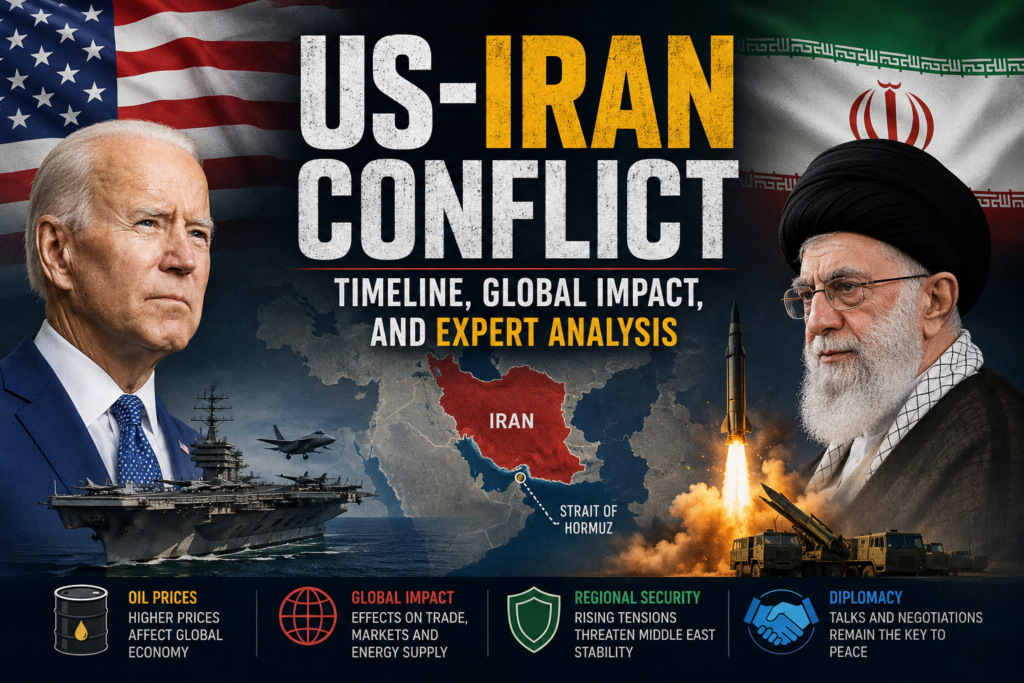
Many people search to understand why these two countries have remained rivals for so long and how this rivalry can affect ordinary people.
In this article, we explain the history of the conflict, the major events that shaped it, its impact on the global economy, and what experts say about the future.
Why Did the US-Iran Conflict Begin?
The roots of the conflict go back to the 1979 Iranian Revolution. Before the revolution, Iran was ruled by Shah Mohammad Reza Pahlavi, who had strong ties with the United States. After the revolution, a new Islamic government came to power and adopted a much more critical position toward Washington.
The relationship became even worse when Iranian students took over the US Embassy in Tehran and held American diplomats hostage for 444 days. Since then, both countries have experienced periods of tension, sanctions, diplomatic disputes, and military confrontations.
The main issues behind the conflict include:
- Iran’s nuclear program
- US economic sanctions
- Regional military influence
- Security concerns involving US allies
- Disagreements over Middle East policies
These issues have repeatedly brought the two countries close to direct military confrontation.
A Simple Timeline of the US-Iran Conflict
1979 – The Iranian Revolution
Iran’s monarchy was overthrown, and a new Islamic government was established.
1979–1981 – US Embassy Hostage Crisis
American diplomats were held hostage in Tehran, creating a major diplomatic crisis.
1980s – Iran-Iraq War
The United States supported Iraq during the war, which further damaged relations with Iran.
1990s – Sanctions Expanded
The US increased economic sanctions against Iran because of concerns about terrorism and nuclear activities.
2002 – Nuclear Program Concerns
International attention focused on Iran’s nuclear facilities, leading to years of negotiations and inspections.
2015 – Nuclear Agreement (JCPOA)
Iran and world powers reached a deal that limited Iran’s nuclear activities in exchange for sanctions relief.
2018 – US Withdrawal from the Deal
The United States withdrew from the agreement and reimposed sanctions.
2020 – Major Military Escalation
A US drone strike killed Iranian General Qasem Soleimani, leading to a sharp increase in tensions.
2020s – Continuing Confrontation
Sanctions, military incidents, cyber operations, and diplomatic disputes have continued to shape the relationship.
Why Is the Strait of Hormuz So Important?
One of the most important reasons the world watches the US-Iran conflict closely is the Strait of Hormuz.
This narrow waterway connects the Persian Gulf to the Arabian Sea. A large share of the world’s oil passes through it every day. If the route is disrupted, energy supplies can be affected within days.
A disruption could lead to:
- Higher petrol prices
- Increased transportation costs
- Rising inflation
- More expensive food and goods
- Pressure on global financial markets
Because of this, any military tension near the Strait of Hormuz becomes an international concern, not just a regional one.
How the Conflict Affects Oil Prices
Oil is the first market that reacts when tensions rise between the US and Iran.
When traders fear that oil shipments could be interrupted, prices often increase. Even the possibility of conflict can create uncertainty in energy markets.
Higher oil prices usually mean:
- More expensive fuel for drivers
- Higher airline ticket prices
- Increased manufacturing costs
- More expensive shipping
- Higher electricity costs in some countries
This is why people around the world may feel the effects of the conflict even if they live thousands of miles away from the Middle East.
Impact on the Global Economy
The conflict affects much more than energy markets.
Financial Markets
Investors often become cautious during geopolitical crises. Stock markets may become volatile, while gold and other safe-haven assets may become more attractive.
International Trade
Shipping companies may avoid high-risk areas, which can increase delivery times and transportation costs.
Inflation
Higher energy costs can spread through the economy, making many products more expensive.
Business Confidence
Companies may delay investments when there is uncertainty about global stability and energy prices.
Economists often describe the US-Iran conflict as a global risk factor because it can influence growth, inflation, and investment decisions across many countries.
Political Impact Around the World
The rivalry between Washington and Tehran has also shaped international diplomacy.
Countries have often taken different positions on issues such as:
- Nuclear negotiations
- Economic sanctions
- Military actions
- Human rights concerns
- Regional security arrangements
Organizations such as the United Nations and the International Atomic Energy Agency (IAEA) have played important roles in monitoring nuclear activities and encouraging diplomatic solutions.
The conflict has also influenced relationships between Middle Eastern countries, creating new alliances and strategic partnerships.
Humanitarian Concerns
Whenever tensions rise, ordinary people face the greatest risks.
Possible humanitarian consequences include:
- Displacement of civilians
- Damage to infrastructure
- Shortages of medicine and essential goods
- Economic hardship caused by sanctions
- Increased unemployment
International organizations have repeatedly emphasized the importance of protecting civilians and maintaining access to humanitarian assistance during periods of crisis.
What Do Experts Say?
Most security experts agree on one thing: a full-scale war would be extremely costly for both sides and for the wider region.
Analysts usually focus on three possible scenarios:
1. Diplomatic Engagement
Negotiations continue, leading to agreements on nuclear activities, sanctions, or regional security issues.
2. Limited Confrontation
Military incidents occur, but both sides avoid a broader war.
3. Wider Regional Escalation
The conflict expands and affects multiple countries in the Middle East.
Many experts believe that diplomacy remains the most effective way to reduce long-term tensions, even though negotiations are often difficult and progress can be slow.
What Does This Mean for Ordinary People?
You might wonder why a conflict in the Middle East matters to someone living in another country.
The answer is simple: energy prices affect almost everything.
When oil becomes more expensive:
- Transport costs rise
- Food prices may increase
- Utility bills can become higher
- Businesses may pass costs on to consumers
So, even if you are not directly involved in the conflict, its economic effects can still reach your daily life.
Frequently Asked Questions
Why are the US and Iran rivals?
The rivalry began after the 1979 Iranian Revolution and has continued because of disputes over nuclear activities, sanctions, regional influence, and security issues.
Has there been a full-scale US-Iran war?
No. The two countries have experienced military confrontations and periods of high tension, but they have not fought a full-scale declared war.
Why is the Strait of Hormuz important?
It is one of the world’s most important oil shipping routes, and disruptions there can affect global energy supplies.
How do sanctions affect Iran?
Sanctions restrict trade, financial transactions, and access to international markets, creating economic pressure on the country.
Could diplomacy solve the conflict?
Diplomacy has reduced tensions in the past, such as during the 2015 nuclear agreement, but lasting solutions require agreement on several complex issues.
Conclusion
The US-Iran conflict is not just a dispute between two countries. It is a major geopolitical issue that influences energy markets, global trade, international diplomacy, and regional security.
Understanding the history of the conflict helps explain why oil prices can change suddenly, why financial markets react to events in the Middle East, and why governments around the world pay close attention to developments between Washington and Tehran.
While tensions may rise and fall over time, the broader lesson is clear: conflicts involving major regional powers can have consequences far beyond their borders. That is why the US-Iran relationship will likely remain an important topic for policymakers, businesses, investors, and ordinary citizens for many years to come.